Dominika Kuźma-Ebel
Across the border in Poland, abortion has spent decades at the center of fierce political and social battles. Ironically, Poland once had some of the most liberal rules in the region. Under a 1956 law passed during the communist era, a pregnancy could be terminated when a woman’s life or health was at risk, in cases of rape, or when the fetus had severe defects. It was also permitted simply because of difficult living conditions. That changed in 1993, when political elites pushed through a much stricter law despite little public pressure to do so.
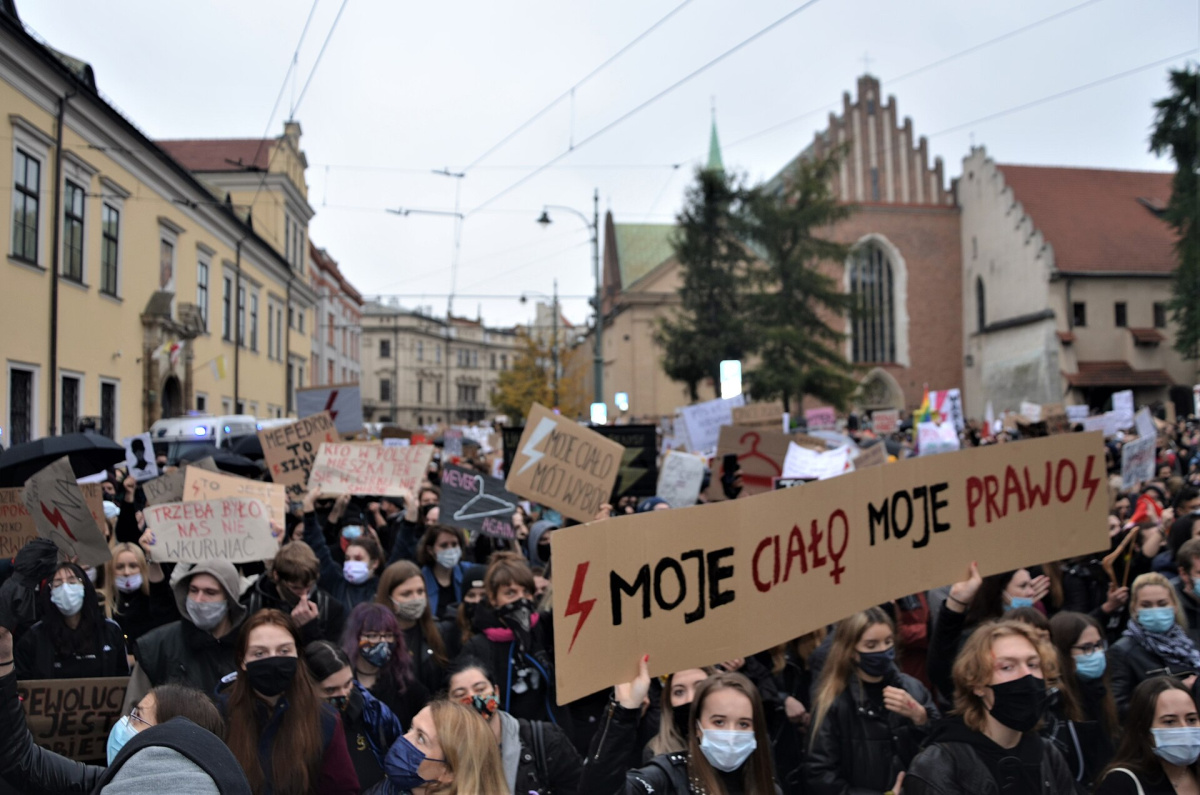
A brief attempt to soften the rules in 1996—allowing abortion on grounds of personal hardship—lasted only months. The Constitutional Tribunal struck it down in May 1997. From then on, Poland’s restrictions only hardened, sparking massive street demonstrations like the Black Protest in 2016 and the nationwide Women’s Strike protests in 2020.
Those 2020 protests erupted after the Constitutional Tribunal ruled that terminating a pregnancy due to severe, irreversible fetal abnormalities was unconstitutional. Today, abortion in Poland is legally allowed essentially only when the pregnancy threatens the woman’s life or health, or when it is the result of a crime. Meanwhile, anyone who helps a woman terminate a pregnancy outside those narrow limits risks criminal charges under the Penal Code, which has carried sentences of up to three years in prison. On paper, legal abortions in Polish hospitals have nearly vanished—official statistics recorded just 75 procedures in 2021. In reality, women haven’t stopped ending pregnancies. Instead, they order abortion pills, travel abroad to places like Czechia, or turn to grassroots support networks such as the Abortion Dream Team, Kobiety w Sieci, and the Abotak clinic. When procedures do happen inside the official system, activists and patients warn that fear and lack of routine have left care lagging behind. Outdated methods like curettage (łyżeczkowanie) are still used in place of modern standards.
Even when a woman meets the strict legal criteria, getting help in a Polish hospital is far from guaranteed. Many doctors are reluctant to perform abortions out of fear of prosecutors, professional repercussions, or political backlash. On top of that sits the "conscience clause," which lets physicians refuse the procedure on moral grounds. Since a 2015 Constitutional Tribunal ruling, doctors who invoke it are not even required to point the patient to another physician or hospital that will perform the abortion. This gap is deeply tied to conservative politics and the influence of the Catholic Church in public life.
In May 2023, 33-year-old Dorota of Bochnia died of septic shock in a hospital in Nowy Targ after being admitted around 20 weeks into her pregnancy with no amniotic fluid left. For three days, doctors delayed decisive action as her condition worsened. The case later led prosecutors to file criminal charges against hospital staff in 2025.
In 2021, the death of Izabela of Pszczyna became a tragic symbol of what happens when doctors wait too long to act. Medical staff monitored a failing pregnancy until the fetus died rather than intervening in time to save the mother from sepsis. In 2025, when Anita of Oleśnica sought a lawful abortion on health grounds in her third trimester after doctors diagnosed severe fetal abnormalities, she was turned away and passed between hospitals. Dr. Gizela Jagielska finally performed the procedure in Oleśnica, which sparked aggressive protests and political attacks against the doctor and the hospital. These tragedies echo earlier landmark cases. Alicja Tysiąc lost much of her eyesight in 2000 after being denied an abortion and later won a 2007 ruling at the European Court of Human Rights, while Prof. Bogdan Chazan withheld information about severe fetal defects from a patient in 2014. Fearing public judgment and harassment, many women choose to stay silent. Meanwhile, activist groups continue to push for change, even petitioning First Lady Marta Nawrocka to speak up for women’s rights.
That long struggle reached a new turning point on October 20, 2026, when Poland’s parliament voted on two separate bills aimed at loosening the restrictions. Lawmakers passed a proposal to restore the right to abortion in cases of severe fetal abnormalities by 233 votes to 203 (with 1 abstention). They also narrowly approved a second bill partially decriminalizing abortion and assistance in terminating a pregnancy by 217 votes to 213 (with 3 abstentions). Both bills have since cleared the Senate and landed on the desk of President Karol Nawrocki. Now, people on both sides of the Czech-Polish border are watching to see whether the president will sign the reforms into law or block them with a veto. Another open question is whether changing the text of the law will finally be enough to lift the climate of fear inside Polish hospitals.